
Time Is Only Epoch
May 24, 2026
- Book reading
- Persona notes
Comments are public and page-specific. Select text to comment on a passage, then tap Comment on this passage; or open Comments for a general note. Highlights point to comments on this web summary, not the PDF.
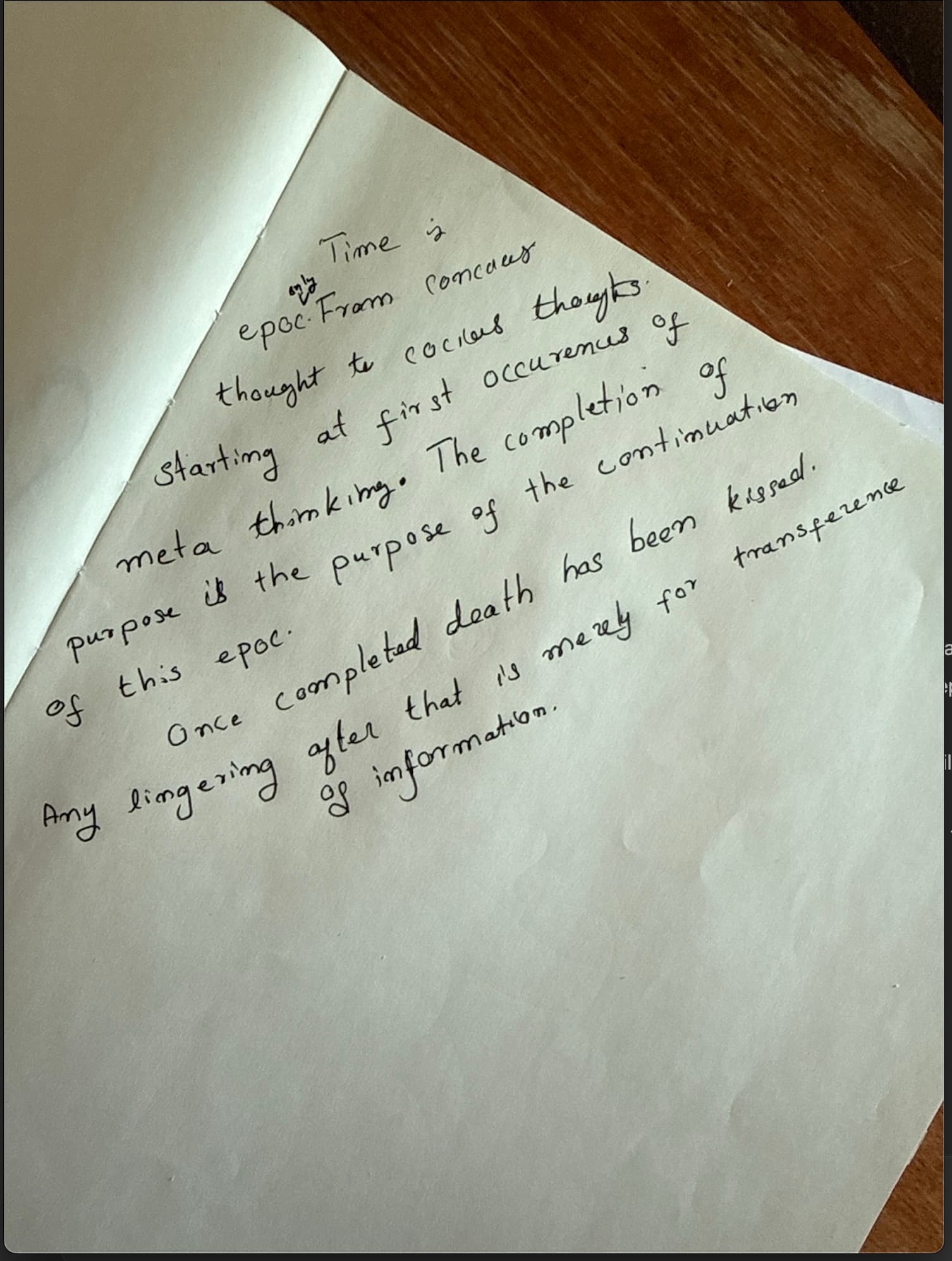
Time is only epoch. It runs from conscious thought to conscious thoughts, beginning at the first occurrence of meta thinking. Before that there is no time, only silence, and no one awake inside it to name a beginning. That first occurrence is the first notch, and from there the epoch runs.
The completion of purpose is the purpose of the continuation of this epoch. We continue in order to complete, and we complete in order to have continued. The reason for going on is to arrive at the point where it is done, and nothing inside the epoch exists for its own sake except this slow closing of the loop between an intention and its end.
Once completed, death has been kissed. Not seized, not suffered, but kissed. The fear we attach to death belongs to what is unfinished, to the epoch cut short before it could complete itself. To complete is to turn the ending into a kiss.
Any lingering after that is merely for the transference of information. It is no longer the epoch living but the epoch being copied out. The self has already happened, and what remains is transmission.
In dialogue with Byung-Chul Han, The Scent of Time: A Philosophical Essay on the Art of Lingering, trans. Daniel Steuer (Cambridge: Polity Press, 2017).
Axiomatic footnote
- D1
E = [t0, t1]
Time is a bounded epoch, not an endless line.
- D2
t0 = first meta-thought
A witness fixes the beginning.
- A1
P = complete(P)
Purpose is a fixed point: continuation aims at completion.
- A2
fear(death) → 0 as incomplete(E) → 0
The fear belongs to incompletion, not to the close itself.
- C
x > t1 => transmission
After the self has happened, what remains is a reading-out.
The logic holds until the final turn, where proof hands off to poem.
Subscribe
Get the next note by email.
Comments
Read public comments on this page, add a general note, or select text above to comment on a specific passage.
No comments yet. Select a passage in the article, or start with a general comment.
First-time comments are reviewed before publishing.